
AI Ad Review
Quality
Framework
Monitoring model quality, policy risk, and reviewer calibration in an AI-assisted ad review workflow.
AI pre-screening introduces risk.
This project simulates how a digital ad platform monitors the quality of an AI-assisted ad review workflow.
A model can be too strict and block valid advertisers, or too lenient and approve ads that should have been escalated. The challenge is to separate advertiser friction from policy exposure, then turn those signals into actions.
Each pillar answers a different question for a different team.
Model quality
Measures AI accuracy, confidence distribution, disagreement rate, and high-confidence wrong decisions that carry the most operational risk.
Policy risk
Separates over-rejection (advertiser friction) from risk misses (policy exposure). Identifies approval misses in high-risk categories.
Reviewer calibration
Compares human accuracy by BPO team, reviewer tenure, market, and policy category to surface training and calibration gaps.
Feedback loops
Uses appeal reversals, ambiguous cases, and high-confidence AI errors to identify retraining opportunities and policy clarification needs.
What the data showed.
Built for operational review.
Route, review, retrain, clarify.
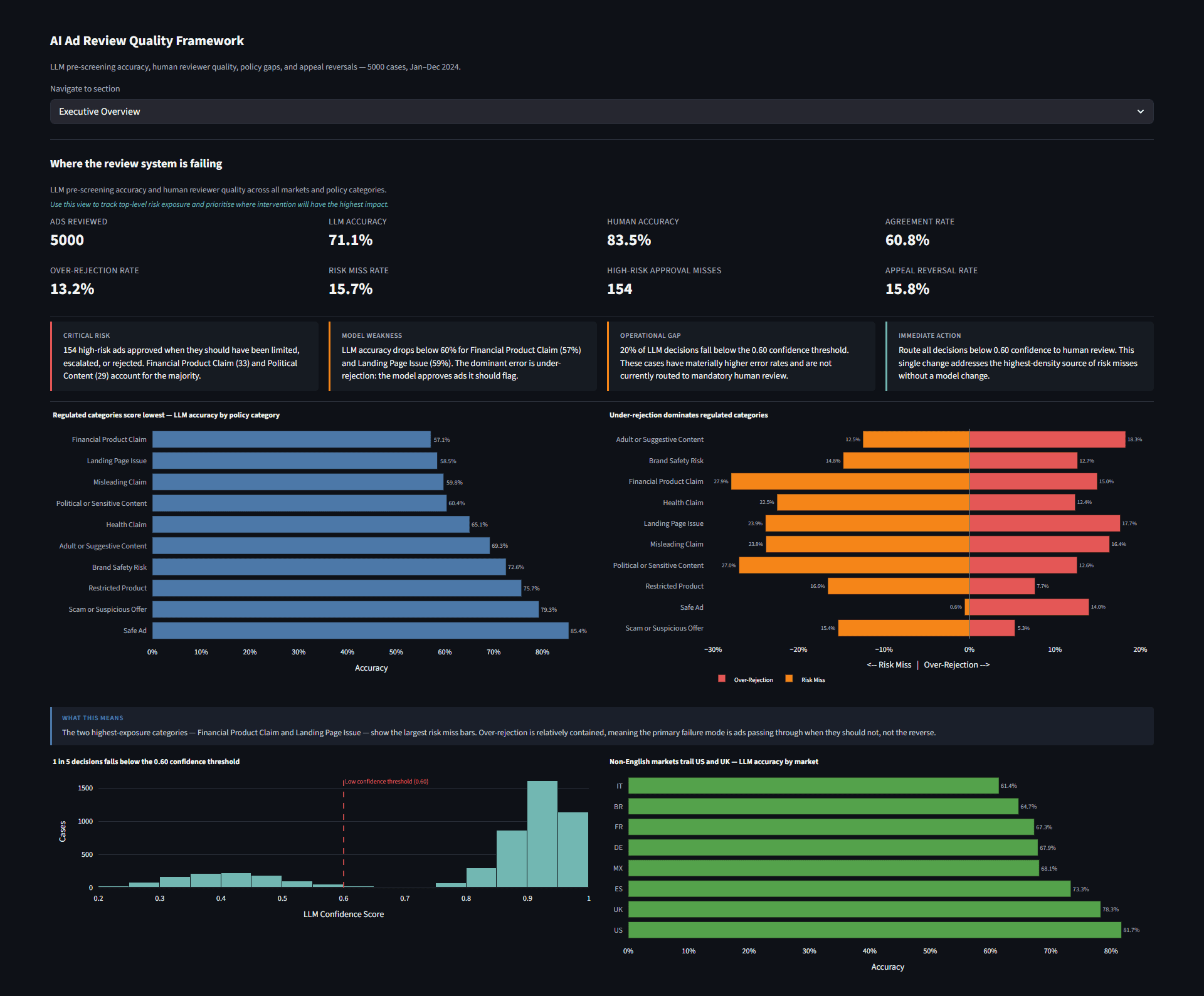
Route low-confidence decisions to human review
AI decisions below 0.60 should not be auto-approved. Routing them to reviewers reduces the highest-concentration error zone.
Review high-risk approval misses weekly
154 high-risk approvals need weekly review. This is a standing operational task, not a one-off audit.
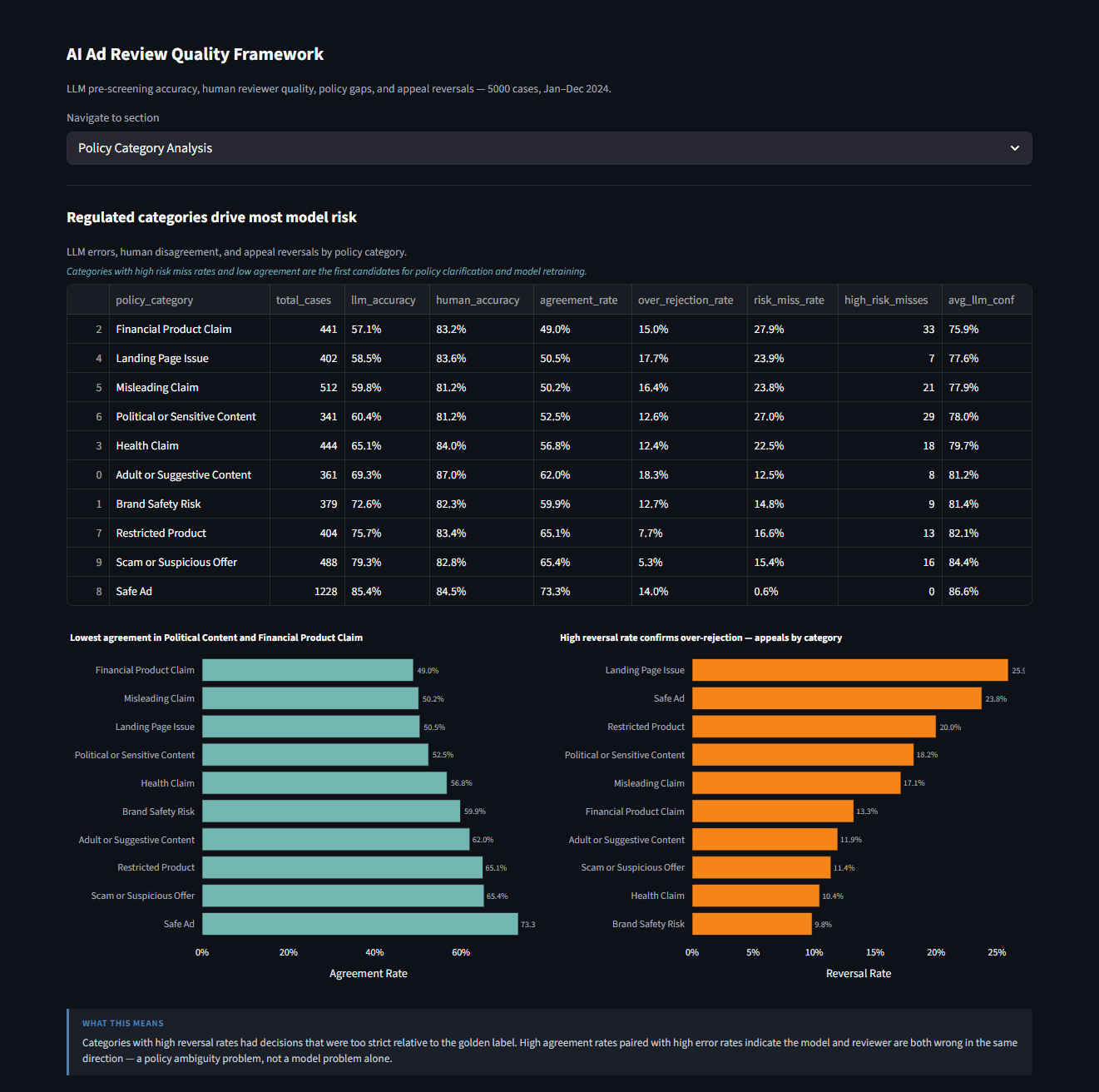
Calibrate reviewers on regulated categories
Financial Product Claim and Health Claim show the widest calibration gaps. These categories need dedicated reviewer training.
Send high-confidence AI errors to the model team
Cases where the AI was wrong with high confidence are the most valuable retraining signals. They should be flagged and routed automatically.
Add market-specific policy guidance
BR, IT, DE, and ES need local policy examples and reviewer guidance to reduce the human-AI disagreement rate in non-English markets.
Use appeal reversals to reduce advertiser friction
A 15.8% reversal rate signals systematic over-rejection in specific categories. Reversals are a direct feedback signal for policy adjustment.
The value is the operating model, not the dashboard.
This project connects model performance, human review quality, advertiser friction, and policy exposure into one decision framework — what to route, what to review, what to retrain, and what policy teams need to clarify.
Generic accuracy reporting is not enough. Quality monitoring requires operational context.
Explore the rest of the work.
The repository includes the synthetic dataset, Python pipeline, SQL analysis, Streamlit dashboard, and full documentation.